

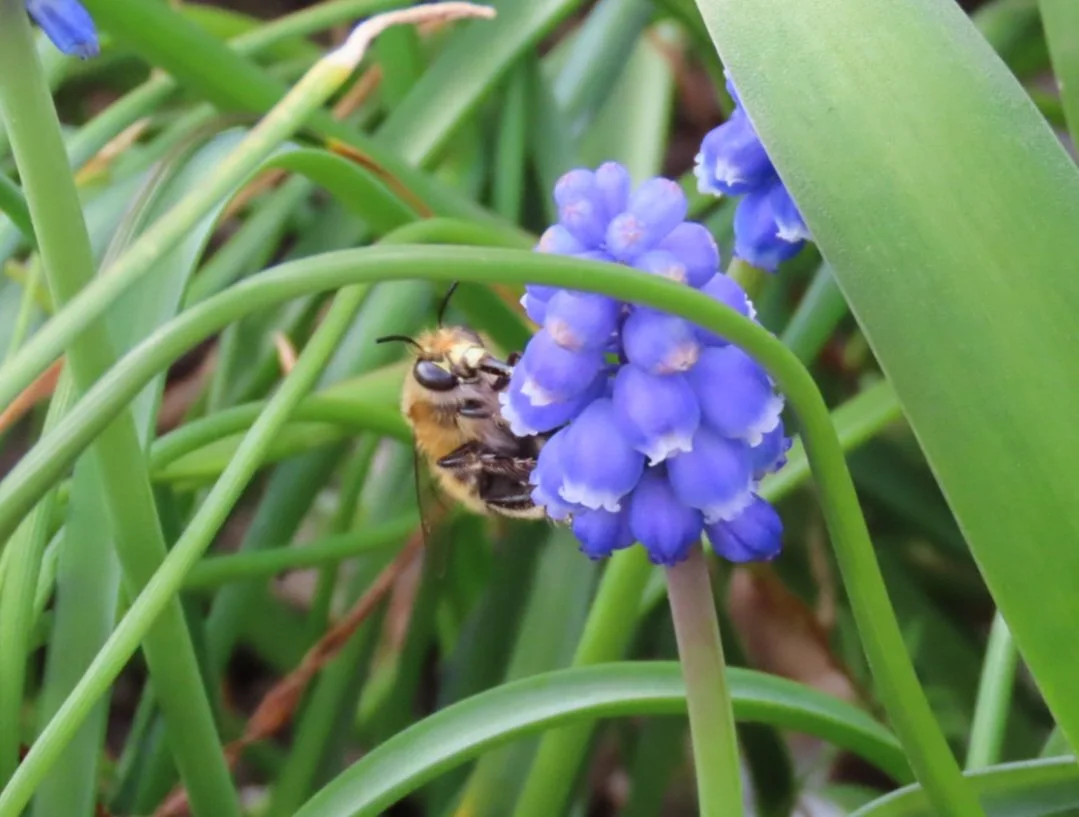
Hairy Footed Flower Bee
Discovering Bees in Your Garden
We all know that bees are a vital part of our ecosystem, and that they are under unprecedented strain in recent times. Climate change, habitat loss, unchecked pesticide use and disease have all taken their toll on these key pollinators.
It’s easy to despair but there are still things that we can do to help them. Many people in our local area are now leaving areas of their gardens wild and are finding that this is encouraging a resurgence in bee numbers as well as butterflies, moths and other insects.
Preserving nature on our doorstep often starts with simply recognising what we have and then learning to care for it. This is exactly what local Rickmansworth resident and author Stephen Younger did. In this blog post he charts his journey from avid birdwatcher to bee enthusiast, and introduces us to the bees we can look out for in our local gardens. He also provides advice on how to attract bees to your own garden and, importantly, where to record your sightings of rare species. So far he’s identified 35 different bee species in his 70 foot suburban garden. How many can you see?
Photo Credits : Stephen Younger
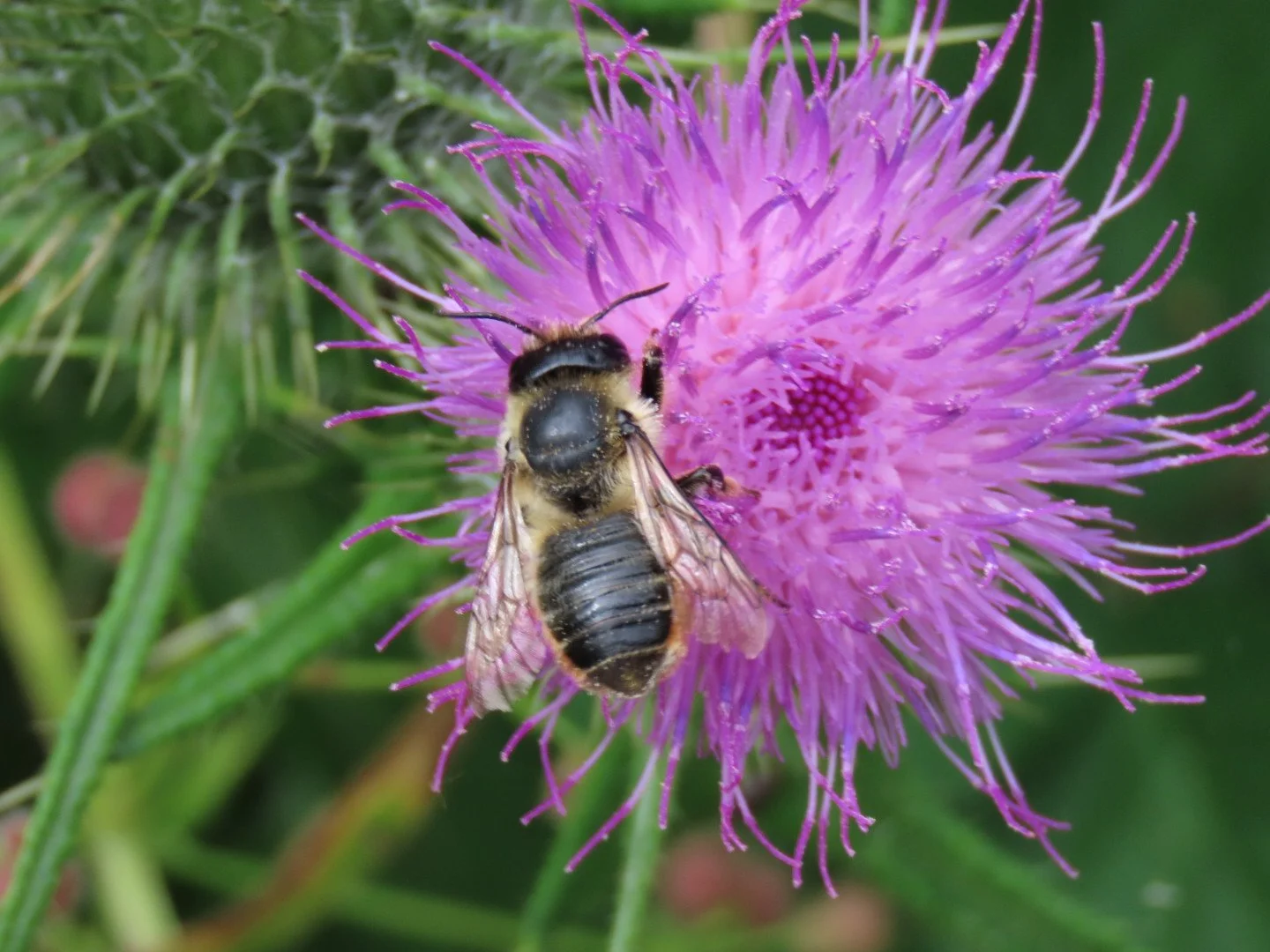
Leaf Cutter Bee
An Introduction to Bee Watching
Lockdown in 2020 gave us all an opportunity to view our environment from a different perspective. Beautiful spring weather saw a lot of us spending more time in our gardens. Horizons were shortened and birding opportunities restricted but I for one started to notice things I’d never previously seen or appreciated. I learned to identify a few different bees in the garden and spent some time searching the internet for clues as to what I was seeing. I really took a liking for Hairy-footed Flower Bees and Ashy Mining Bees, two of our commoner species but both full of character. I couldn’t believe that it had taken me over fifty years to notice them!
Early in the first Covid lockdown, I was looking out of the back garden window when a huge bee caught my eye feeding on a salvia plant. I was able to approach it and realised it was one of the big, exotic species that I had seen during holidays in southern Europe. A check online confirmed its identity – a Violet Carpenter Bee.
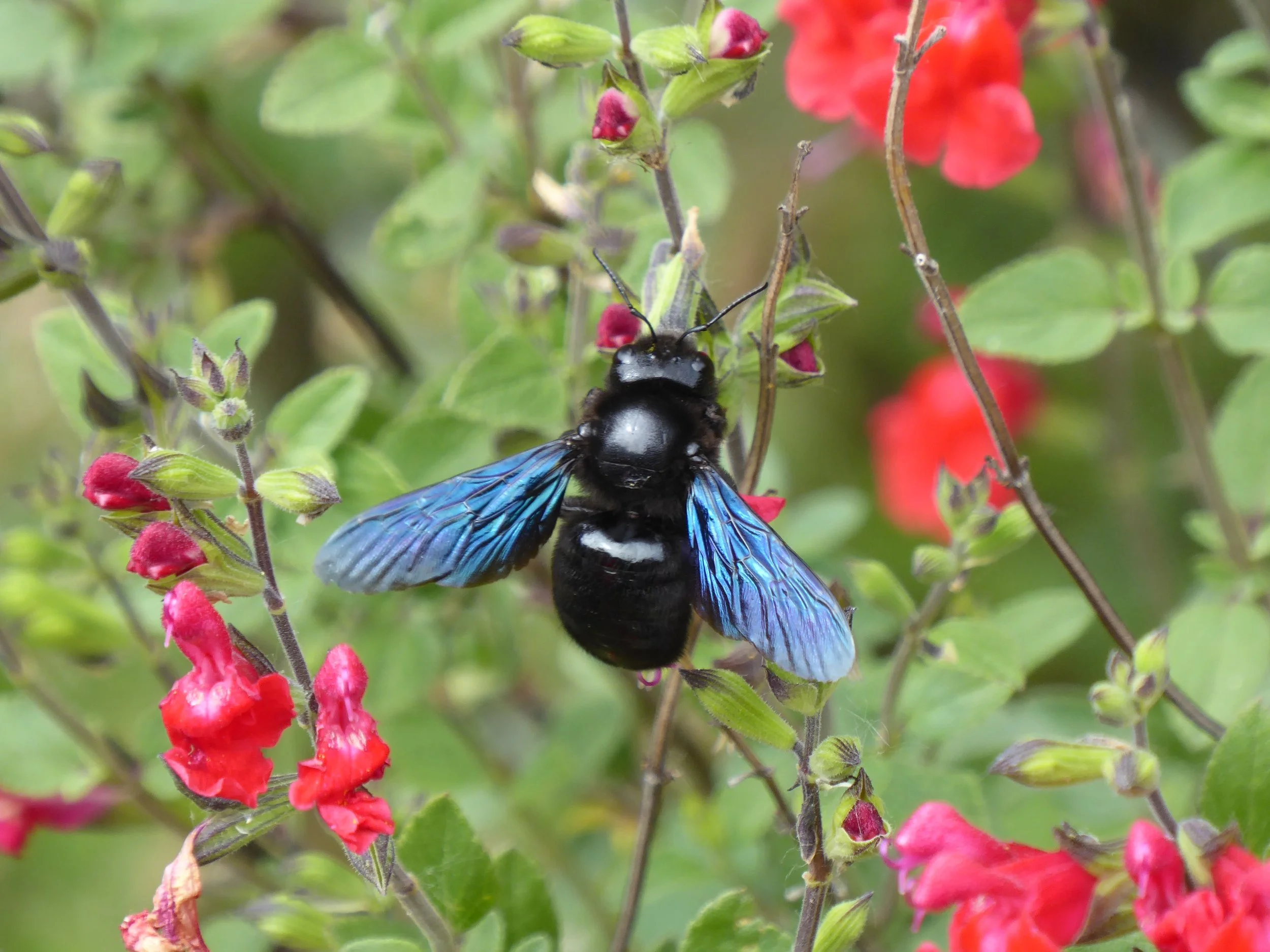
Violet Carpenter Bee
Violet Carpenter Bee
Violet Carpenter Bees are hugely impressive insects, with a purplish sheen to their black body and dark purple veins on their wings. The buzz of the one I saw in the garden was almost intimidating as it took off and checked me out. And it was really quite rare, rarer in fact that pretty much any bird I had ever found in the area. Only one had definitely been recorded previously in Hertfordshire, and while some almost certainly go overlooked or unrecorded, this was clearly something special.
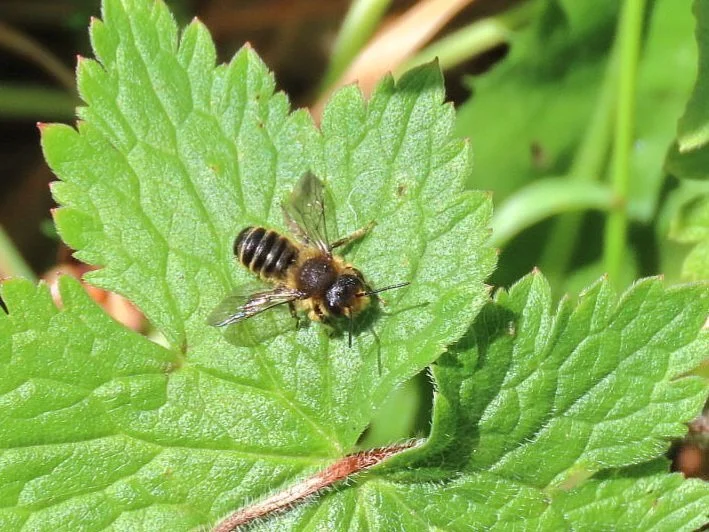
Blue Mason Bee
Slow Down and Zoom In
Crucial to the development of my bee-watching hobby was the acquisition of a good camera. My Canon Powershot is by no means top of the range, but it has an excellent zoom and good macro settings. I started to take photos of bees and study these afterwards to try to identify what I had seen.
I quickly learned that looking for bees is quite different to birdwatching. It feels like stepping into a different dimension, with everything happening on a much smaller scale. While a nature reserve or woodland might constitute a ‘patch’ on which to focus birding, my seventy-foot garden in Rickmansworth quickly became my patch for beeing.
In stepping into this dimension, other bees start to come into view. I certainly didn’t appreciate just how small some bee species are. The tiny yellow-face bees are the smallest, some measuring under four millimetres in length. Zooming in on photos reveals them to be small but perfectly-formed.
Patience is key, but you also have to be quick. Each bee has its own characteristic behaviour, and some types really don’t hang around long to wait for you to get your ID-clinching photo. Flower-bees in particular seem almost never to settle, although with patience you can watch them and find where they pause to take a breather in a sunny spot.
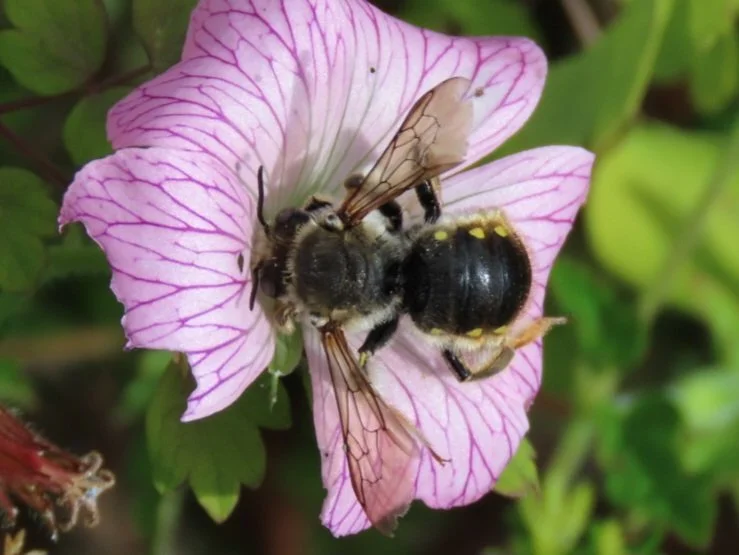
Wool Carder Bee
Common Bees to Look Out For in Your Garden
There are over 250 species of bees in the UK, of which bumblebees are the most prominent visitors to garden flowers. Buff-tailed Bumblebees are the archetypal bee, with two gingery-yellow stripes on their black bodies and a buffish or whitish tail. Common Carder bees have ginger furry bodies and also frequent gardens throughout the summer. Garden Bumblebees have an additional yellow stripe and are especially fond of foxgloves, while Red-tailed Bumblebees are easy to spot, being all black with a distinct orange-red tail.
Honey-bees are smaller and slimmer than bumblebees and are fond of lavender and other garden flowers. Their body colour can vary but they almost always show one or two orange stripes just behind the wings.
Mining bees are a large group of solitary bees, the majority of which appear in early spring to coincide with the blooming of blossom on fruit trees. Structurally they are quite similar to honey-bees but most are smaller, furrier and have narrower bands on blacker bodies.
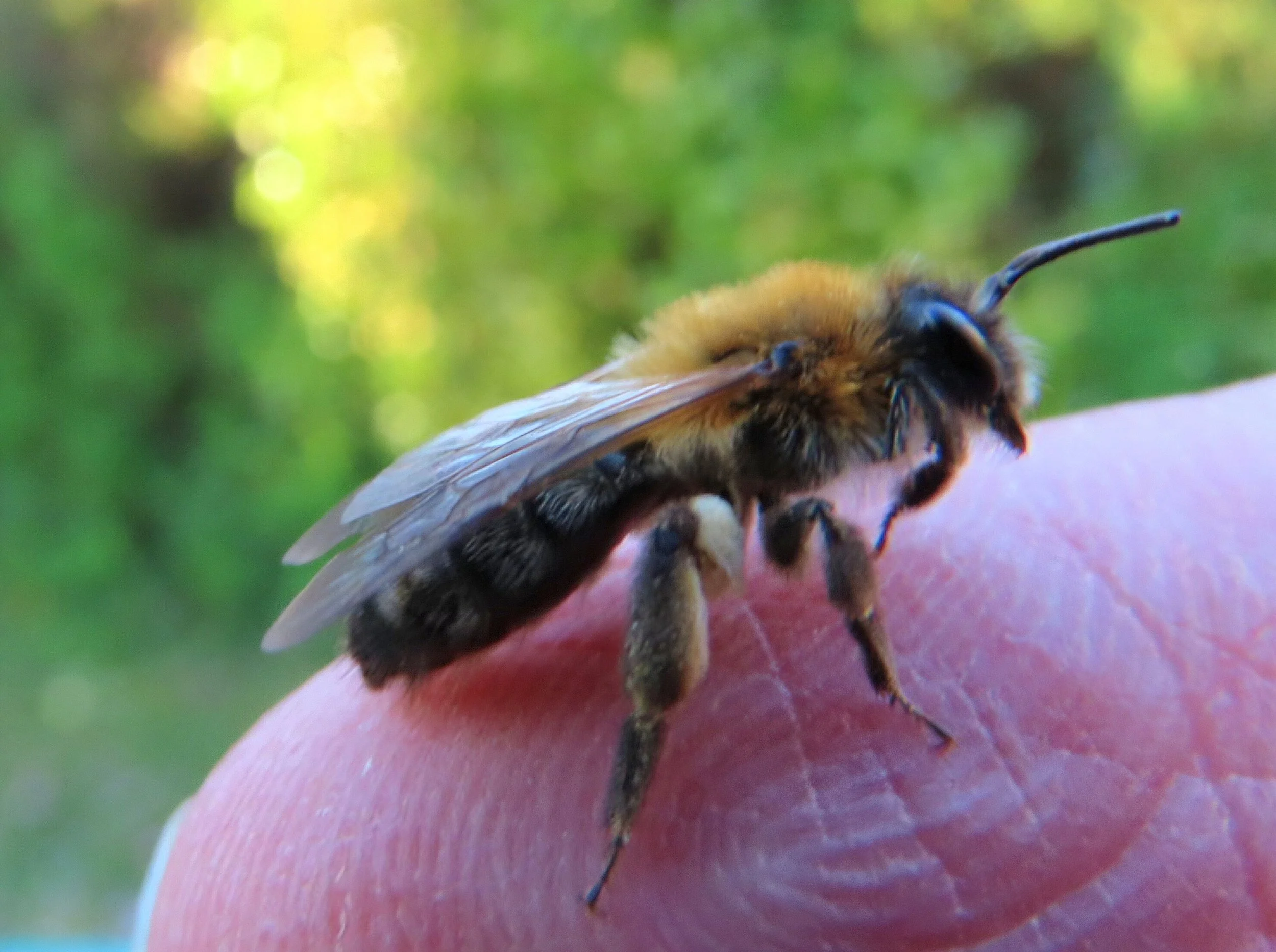
Grey Patched Mining Bee
Rarer Garden Bees
Leafcutter bees look similar to mining bees but collect pollen on brushes on the underside of their abdomen rather than on their legs. Identification to species level is tricky but they readily take to bee hotels, and can be seen carrying neatly-cut leaf sections to their holes. Mason bees also collect pollen on their bodies and also nest in holes alongside leafcutter bees.
Nomad bees look like small, slender wasps and are nest parasites of several species of mining bee. It’s best not to worry too much about what goes on in those underground burrows but as someone once said, if you have a lot of nomad bees it must mean that you have even more mining bees.
Once you get your eye in, you can start to look out for the groups of very small bees. Furrow bees, scissor bees and yellow-face bees are among families of bees just a few millimetres in length.
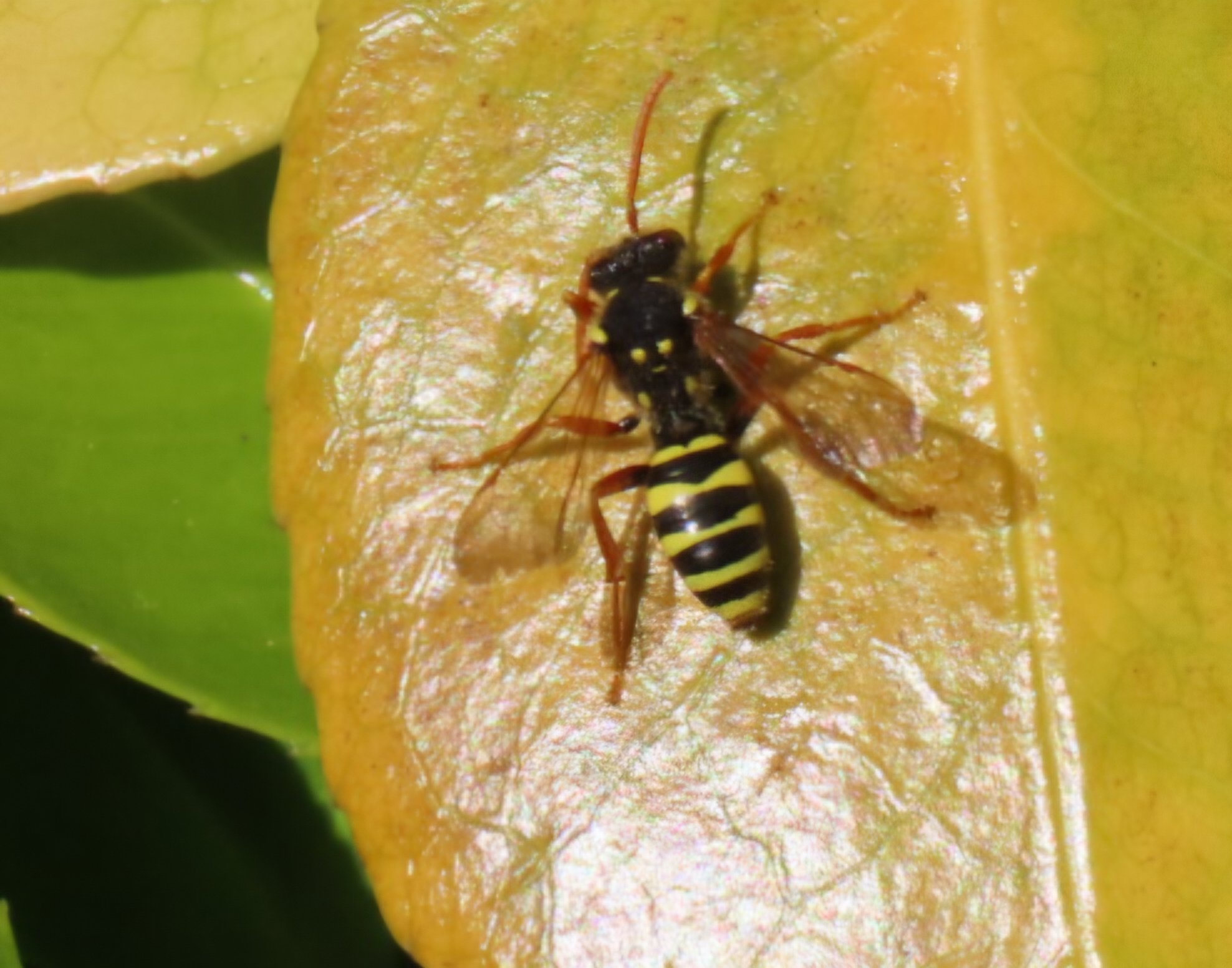
Gooden’s Nomad Bee
Attracting Bees to Your Garden
Even small gardens provide a valuable refuge for bees, both as sites for nesting and for a supply of pollen and nectar-rich flowers. In an ideal world, they should also provide a pesticide-free environment, or at the very least a place where pesticides aren’t directly applied.
Bee hotels are widely available but it’s very easy to make your own. Bundles of hollow bamboo canes are ideal, or you can drill holes of varying sizes in bricks or solid wood to provide nesting sites for leafcutter and mason bees.
Lavender is always popular with bees although research suggests that some varieties such as ‘Dutch Lavender’ are better than others. I have found that Cranesbill flowers have attracted a lot of the more unusual bees to my garden, and grape hyacinth is especially favoured by Hairy-footed Flower Bees in March and April. During the autumn, try to put aside a patch of ivy which will almost certainly attract Ivy Bees, a recently-discovered species of mining bee which was first recorded in Britain in 2001 and is now well-established in our area.
It’s a good idea to relax your definition of weeds in order to provide bees with a wider variety of flowering plants on which to feed. Catsears, which look like skinny dandelions and often grow in my lawn, are very attractive to a range of smaller bee species and flower for a long period. A good rule of thumb is to try to have as big a range of plants in flower as possible throughout the warmer months.
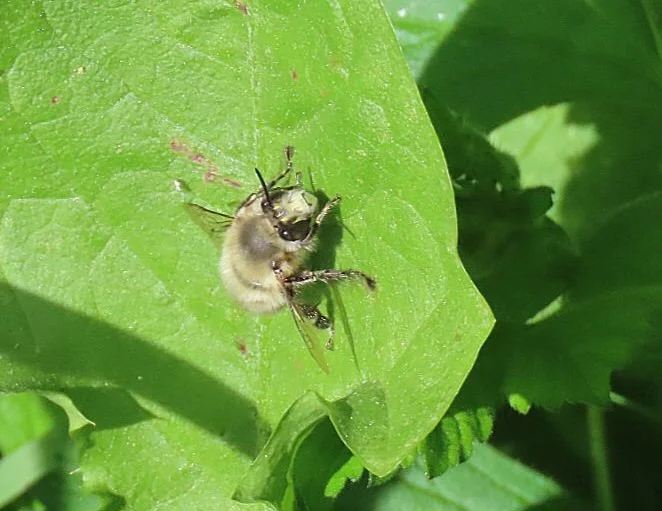
Hairy Footed Flower Bee
Recording your Bee Sightings
Sadly, almost all bee species are in decline both here and across Europe. This is due to a combination of pesticide use, climate change and general habitat loss and degradation.
There are a number of websites and apps available through which to record your bee sightings. iRecord is possibly the most comprehensive and I’ve recently installed the ‘Obsidentify’ and ‘Beemachine’ apps on my phone. I am still very much a novice when it comes to identifying bees and while these apps are probably wide of the mark sometimes, they have proved very useful in suggesting which species I might be seeing.
For those of us who still enjoy something physical rather than virtual, Steven Falk’s Field Guide to the Bees of Great Britain and Ireland is excellent. It has comprehensive text and illustrations of all species in the UK and Ireland, although it does get quite technical and you need to get to grips with your tergites and scutums.
Keeping a list of bees can be rewarding and is a good way of understanding the variety of species that are visiting your garden. So far I’ve identified around 35 species but I’m sure I’ve missed a few – and I expect I’ll make corrections to my list as I continue on my learning curve.
This article was written by Stephen Younger, long-term local birdwatcher and author.
All photo credits - the author.